
Practical ways to protect margins this spring
Milk prices are under pressure, so farms across the country are focusing on cost control. Feed typically accounts for around 70% of variable costs on most farms, making it an obvious target for savings.
However, poorly targeted cuts can quietly undermine cow health, fertility and long-term performance—ultimately proving to be penny wise and pound foolish.
The most resilient farms take a more strategic approach – identifying savings that don’t compromise the cow, while protecting feed efficiency, milk solids and future productivity. There are many practical, low-cost actions that can help safeguard margins now without storing up problems for later.
Consider running a leaner, more efficient herd
A lean herd of fewer, better-performing cows is almost always more profitable than a larger herd diluted by poor performers. While recent record high feed:milk meant it was profitable to feed even the lower performing animals in the herd, the economics have changed very quickly and - luckily - this also represents a cashflow opportunity for many.
“The fastest route to lower costs and improved cashflow in a challenging milk price environment is removing cows that are already costing money,” advises Kevin Doyle, technical manager at Phileo UK & Ireland. “These include chronically lame cows and high SCC cows as well as persistent mastitis cases and persistently infertile cows."
Once the obvious passengers are gone, review performance data and consider removing low yielders, cows consistently below herd average for milk & solids and repeat breeders.
Removing the bottom 10% often raises the average performance of the remaining herd and frees up forage, cubicle space and labour. This is especially true where stocking rate is at or above capacity in terms of shed space, feed space or forage production, where increased competition for feed, lying space and water raise disease pressure and quietly erodes performance.
“At present, cull prices are strong, making this decision even more compelling in the short term,” says Kevin. “In addition, every cow removed saves on average 10-14kg of dry matter intake per day. At herd level, this can quickly translate into tonnes of silage saved per month.”
The value of cow comfort
Rumen efficiency, feed conversion and milk solids depend as much on cow behaviour as ration formulation.
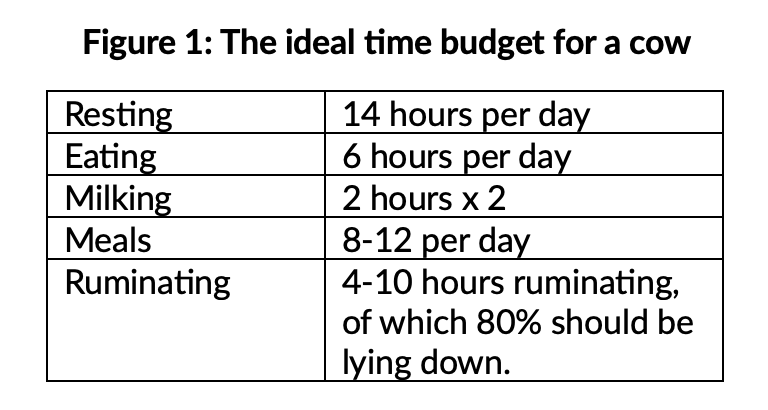
“Cows are prey animals with a strict time budget split across activities like eating, drinking and lying down ruminating. As a rule of thumb, every extra hour spent lying down chewing the cud is worth roughly one litre of milk,” says Kevin.
Figure 1 illustrates how a cow’s day should be ideally spent. If buildings, milking protocols or feeding patterns don’t enable this balance, you could be compromising milk yield, butterfat and hoof health.
Check headfeed space
Insufficient feed space drives competition, encourages slug feeding and destabilises rumen pH.
“Target an absolute minimum of 60cm per cow, but ideally 75cm per cow,” advises Kevin. “As a quick check, this looks like 8 cows per 4.8m bay or 10 per 6m bay (maximum) and ideally 6 cows per 4.8m bay and 8 per 6m bay.”
If headfeed space or cubicle availability is below 100%, carrying extra cows is usually a false economy. Research from the USA by Sova et al 2013 found that for every extra 10cm increase in head feed space there was a 0.06% increase in group average milk fat and a 13% reduction in group average SCC. Simple, low-cost changes – such as adjusting neck rail height and position – can also significantly improve intakes and cow flow at the barrier.
Focus on Pre Peak: Early Lactation
“Particular focus should be on meeting nutritional needs in early lactation to optimise peak production,” explains Kevin. “Every additional 2 litres at peak milk typically delivers around 450 litres extra milk over the full lactation, with better persistency and improved fertility.
"The transition period and early lactation are the most metabolically demanding phases of a cow’s life. If feed intake and nutrient supply fall short at this stage, the knock-on effects can be felt for the rest of the lactation and into the next.”
Talk to your feed advisor about how you can tighten feed efficiency without starving performance. This might include:
- Rebalancing rations to maximise forage use by complementing the forages on your farm rather than substituting.
- Grouping cows more precisely so high yield diets go only to cows that justify them.
- Reviewing feed waste: trough losses, feed refusals, silage face management
Rumen health is crucial
Rumen health sits at the centre of milk yield, milk solids, fertility and resilience. As rumen pH drops, fibre digestion falls sharply, feed efficiency declines, butterfat is suppressed and inflammation increases.
“Digestible fibres (e.g. beet pulp, soya hulls and wheatfeed) are in limited supply in the marketplace currently which means starch inclusion may be higher than usual in diets, and when pricing feed options this must also be factored into the final price per tonne," continues Kevin.
“This brings with it an increased risk of sub-acute ruminal acidosis (SARA) - a major hidden cost. When digestible fibre is scarce, chop length becomes critical. Aim for chop lengths for grass silage of 2-4 cm (go longer if fibre is limited) and straw of 3-5 cm.
“Longer pieces increase sorting, while shorter reduces effectiveness in the rumen. The aim is to have long enough fibres to stimulate rumination, yet short enough to maintain consistent intakes and reduce sorting.”
Simple, regular observation remains one of the most cost-effective management tools available to spot early warning signs of reduced rumen function. Look out for cow signals like:
- Reduced cudding rates (less than 65% of cows lying down)
- Loose or bubbly dung
- Mucin tags in manure
- Rapid butterfat drops or altered fat:protein ratios
- Excessive body condition loss in early lactation
“In a tough milk price year, the last thing farmers need is hidden energy losses from poor rumen function,” says Kevin. “Even small drops in rumen pH can translate into reduced fibre digestion, lower intakes, reduced milk output and poorer fertility.
"Low rumen pH and SARA are also known to reduce butterfat percentage directly, while also amplifying butterfat suppression caused by poly unsaturated fatty acids (PUFAs), found in some feed ingredients. Therefore, in a low milk price environment, protecting milk solids through rumen stability can make a meaningful contribution to margin.
"Supplementation with Actisaf® can improve rumen efficiency and allow cows to do more with the same feed – a critical advantage when margins are tight.”
Actisaf® Sc 47 is a live yeast probiotic that supports the growth of specific microbes that digest fibre and stabilise pH in the rumen. Research from the University of Nottingham found that feeding 10g/day of Actisaf® increased NDF digestibility by more than 6% and delivered an additional 2.8kg ECM per cow per day from the same dry matter intake, improving feed efficiency by 5.5% without compromising body condition, health or fertility.
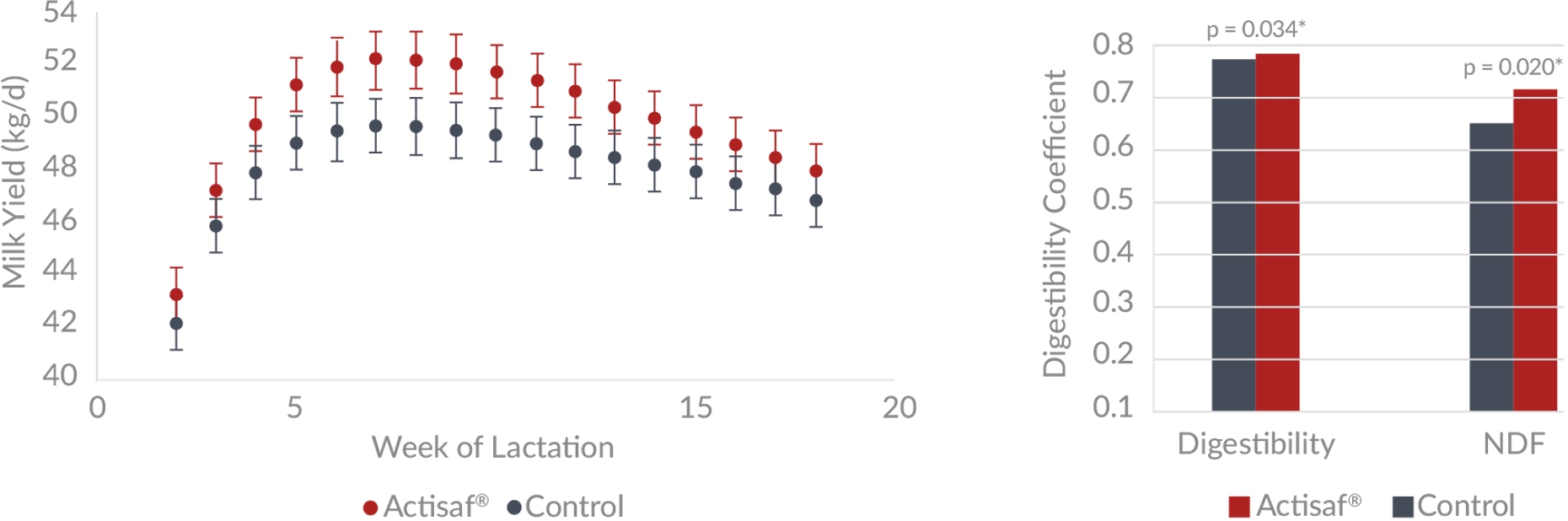
By improving feed efficiency, reducing the risk of SARA and providing a range of other benefits, it can help lower the cost of production by up to 1ppl – delivering an 8:1 return on the cost.
For a farm supplying 1,000,000L this equates to £10,000 per year, presenting a significant opportunity this spring.
Learn more about Actisaf® in dairy systems by clicking here.
Building resilience for the next milk price rise
It’s important to remember that milk prices will improve again, and the farms best placed to benefit will be those that:
- Have lean, efficient herds
- Protect cow health and fertility
- Maximise feed efficiency and milk solids
- Focus on low-cost litres rather than total cow numbers
By feeding fewer cows better, protecting rumen function and prioritising cow comfort, producers can lower costs today without compromising tomorrow.
Related Tech Info

Managing forage challenges and supporting rumen function
A focus on management and nutrition during the 3 weeks pre- and post-calving makes all the difference to performance in the n...
The transition period sets the foundation for a cow’s lactation performance and future productivity. Kevin Doyle explores the...